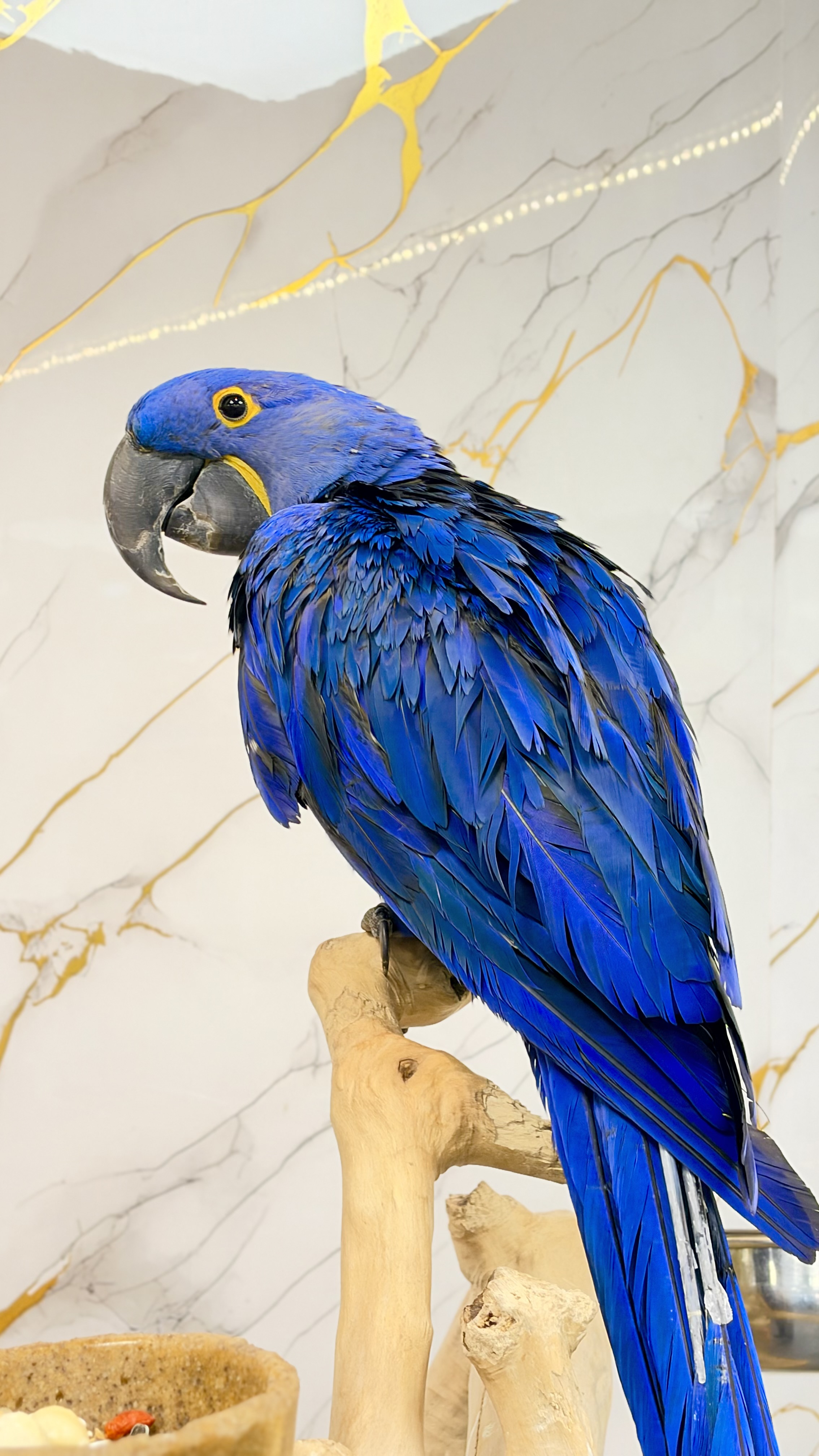
The hyacinth macaw (Anodorhynchus hyacinthinus) is the largest species of parrot in the world, known for its striking cobalt-blue plumage and powerful black beak. It is native to central South America, primarily inhabiting open woodlands, palm groves, and riverine forests. The species feeds mainly on hard palm nuts, which it can crack using its exceptionally strong beak. Hyacinth macaws are highly intelligent, social birds that form long-term pair bonds, but they are classified as Vulnerable due to habitat loss and illegal wildlife trade.
Overview
The Hyacinth Macaw (Anodorhynchus hyacinthinus) is renowned as the largest flying parrot species, measuring about 100 cm (39 in) in length. This striking bird is characterized by its brilliant cobalt-blue plumage, yellow eye rings, and a strong, curved beak designed for cracking tough nuts. Its size, beauty, and social nature make the Hyacinth Macaw a notable species among avian enthusiasts and conservationists alike.
Physical Description
Hyacinth Macaws exhibit a striking appearance with their vivid blue feathers that shimmer in sunlight. Adults generally weigh between 1.2 to 1.7 kg (2.6 to 3.7 lbs). Their beak is a prominent grayish-black color, powerful enough to crack open hard palm nuts, which are a significant part of their diet. The eye rings are a bright yellow, providing a stark contrast to their plumage and enhancing their expressive facial features. Juveniles resemble adults but have a less vibrant coloration and their beaks are not as large.
Similar Species
The Hyacinth Macaw shares its genus, Anodorhynchus, with the Lear's Macaw (Anodorhynchus leari), which is smaller and has a more greenish-blue coloration. Both species are distinguished from the Blue-and-yellow Macaw (Ara ararauna) and other macaws by their unique coloration and size. While Blue-and-yellow Macaws have a more varied color palette with yellow and green, the Hyacinth is noted for its uniform blue appearance.
Range And Habitat
Hyacinth Macaws are native to the central and eastern regions of South America, primarily found in Brazil, Bolivia, and Paraguay. They inhabit tropical savannas, gallery forests, and palm swamps, often near rivers. Their preference for palm trees, particularly the acuri palm (Mauritia flexuosa), is crucial for nesting and feeding, as these provide both food and shelter.
Behavior
Hyacinth Macaws are social birds that live in pairs or small groups. They often engage in playful behavior and have a range of vocalizations, including loud squawking. Their intelligence is notable, as they can solve problems and use tools to access food. Key behavioral traits include:
- Strong pair bonding, often forming lifelong partnerships.
- Communication through body language and vocal sounds.
- Nesting in tree cavities, usually in high palms.
Conservation
The Hyacinth Macaw is classified as Vulnerable by the IUCN due to habitat loss, primarily from deforestation and the illegal pet trade. Conservation efforts are underway, focusing on habitat protection and rehabilitation, as well as regulations to curb illegal trapping. Organizations are also promoting awareness and education about the importance of preserving this majestic species and its natural habitat.
Related pages
See related pages below.